

Ali Cherri Awarded 2025-26 Gardner Film Study Center Fellowship
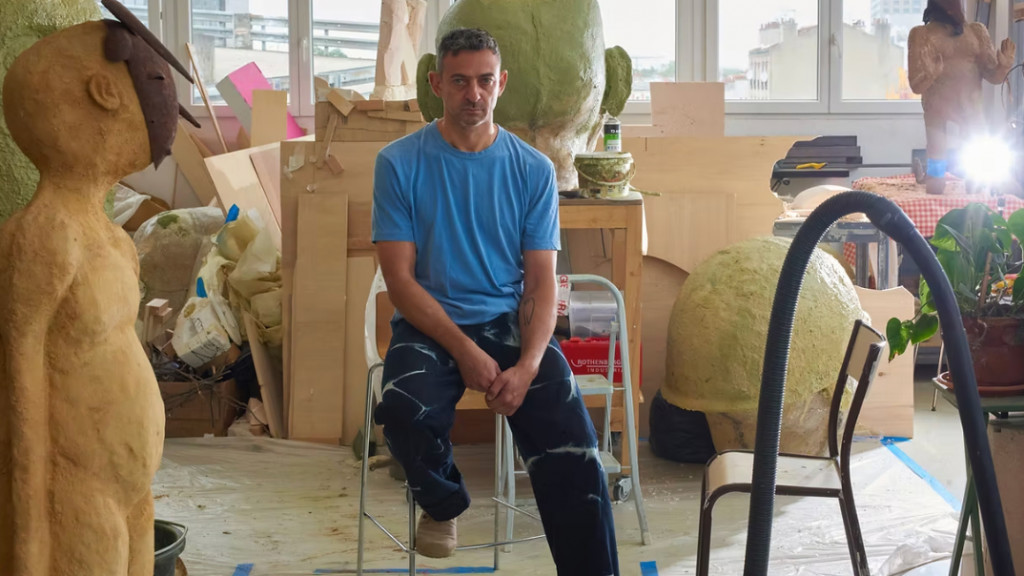
The Film Study Center is pleased to announce that artist and filmmaker Ali Cherri has been awarded the Gardner Film Study Center Fellowship. In collaboration with the Carpenter Center for Visual Arts, we are thrilled to welcome Ali Cherri to screen his film The Dam, and be in conversation on Wednesday, March 4, at 7pm in the CCVA Theater. Cherri will also join the FSC and AFVS community for studio and class visits, screenings, and discussions.
Exploring different geographies of violence in his native Lebanon but also in the broader region, Ali Cherri (b. 1976, Beirut) is a Paris-based artist with three decades of artistic practice spanning across film, performance, sculpture – in terra and bronze -, drawing, and installations, interrogating the ways in which political violence disseminates into people’s bodies and the physical and cultural landscape. Shaped by the vibrant artistic scene of postwar Beirut in the 1990s, Cherri began to investigate the sensorial coproduction of reality between images of conflict, the urban fabric and his own body.
Through the moving image and the accidented journeys of cultural artifacts, the artist discovered in the visual analysis of the political construction of history, the underlying intimate relationship between narratives of cultural value, the configuration of the past and violence itself. In a series of interventions on archaeological collections, Cherri sets out to confront the traditional signifiers of value in the museum by reintroducing fragments and artifacts that had been otherwise discarded in the form of hybrid creatures that embody the history of archaeology as a tale of colonial violence.
His film tetralogy, The Disquiet (2013), The Digger (2015), The Dam (2022), and The Watchman (2023), the subject of accolades and presentations in institutions as well as film festivals, is an extended meditation on political landscapes, from Lebanon to Cyprus and Sudan, imprinted with the traces of past events. Cherri is the recipient of the Silver Lion Award at the 59th Venice Biennale. In Venice, the video installation Of Men and Gods and Mud (2022) brings together our current predicament at the intersection of ecological disaster and the search for new grand narratives.
Mud, the primeval matter of our creation stories, both resilient and fragile, signals a new sculptural direction for the artist. In his most recent institutional exhibitions, Humble and quiet and soothing as mud (2023) at Swiss Institute and Dreamless Night (2023) at GAMeC, Cherri brings mud to life with monumental eagles, soldiers or the transtemporal history of mankind, blurring chronologies and alerting us to the latent dangers of civilization as an inherently destructive process. The telluric movements of history in Cherri’s work draw us towards a cartography of impermanence.
The artist’s expanded dialogue between art, archaeology and the fabric of historical time brought him recently in conversation with the work of modernist sculptor and painter Alberto Giacometti, around the representation of the human face in the exhibition Envisagement (2024) at the Institut Giacometti in Paris. The interposition with Giacometti’s sculptures and paintings brings to the fore not only Cherri’s interest in the body and history, but also on the afterlife of artifacts and museological narratives. Ali Cherri’s exhibition Dreamless Night opened in Frac Bretagne in February 2024.
— Ari Akkermans, writer and art critic
The Gardner Film Study Center Fellowship
The Gardner Film Study Center Fellowship, established in 2014 in the name of pioneering filmmaker and FSC founder Robert Gardner, is awarded annually to outstanding filmmakers from around the world. Robert Gardner served as the FSC’s Director from 1957 to 1997 and was a faculty member in the Visual and Environmental Studies Department at Harvard University (now Art, Film, and Visual Studies). An internationally renowned filmmaker and author whose works have entered the permanent canon of non-fiction filmmaking, his major films include Dead Birds (1964), a lyric account of the Dugum Dani, a Stone Age society at one time living an isolated existence in the Highlands of the former Netherlands New Guinea (Gardner was the leader of the Peabody Museum-sponsored expedition to study the Dani in 1961-62); Rivers of Sand (1974), a social commentary on the Hamar people of southwestern Ethiopia; and Forest of Bliss(1985), a cinematic essay on the ancient city of Varanasi, India, which explores the ceremonies, rituals, and industries associated with death and regeneration.